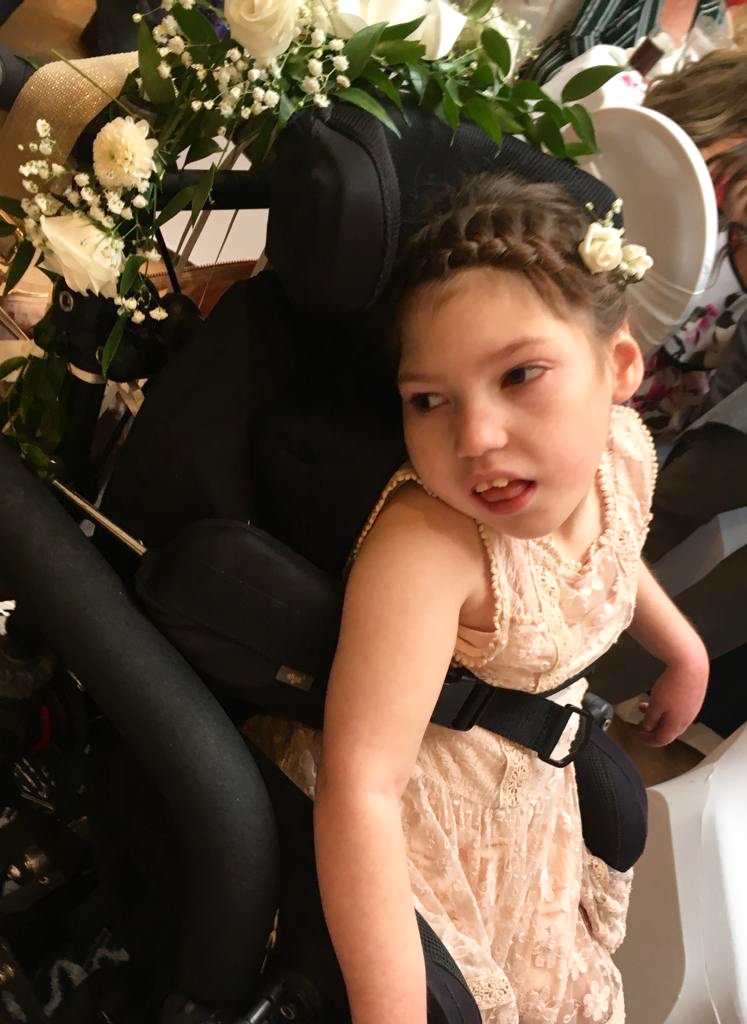
Far be it from me to over- sentimentalise anything (ha!), but as I've sat down to write this blog post Louis Armstrong's "Wonderful World" has come onto the radio. I have just realised that my favourite lyric from this song could not be more pertinent to this post, which is handy because I didn't know how I was going to start this one and here we are, four lines in. Thanks, Louis!!
I see friends shaking hands, saying "How do you do?"
They're really saying I love you....
Well, if Louis Armstrong thinks friends asking how you are is an expression of love then we are all feeling very loved at the moment! The sheer amount of people wishing us luck before the big day and then asking how our appointment at St Thomas's Hospital in London went last Thursday (not just friends actually but professionals involved with Elin too) following our return has bowled us over. I always know that Elin has a team of people behind her, loving her and rooting for her but this was particularly apparent this week. I want to say thank you to everyone who spoke to me about it either beforehand or afterwards. Your interest means more than you can ever know and we are truly grateful. It makes everything just that little bit easier.
I have been saving a full explanation of the appointment for the blog, for anyone who is interested. It's taken a while to get my head around everything that the Neurologist talked with us about and I'm looking forward to getting his report so that I can reiterate it all in my own head. Until then I'll do my best to summarise.
Firstly, getting to London wasn't as bad as we feared. It is a journey we do regularly but not to pretty much directly onto Westminster Bridge! Leaving at three o'clock in the morning was not fun but it did mean that Elin was still very sleepy and had the advantage of night time meds in her system. So she sat beautifully all the way down, which made it much less stressful than it could have been. We got to the Hospital early enough for a parking space and a coffee! So a good start.
I had been nervous that we might not get to see Dr Jean Pierre Lin himself, as the letter stated it could be one of his 'team'. Dystonia forums had reassured me that his team were also excellent but in my heart I really, really wanted to see the main guy. He is the leading Dystonia expert in the country if not the world. When he came into the waiting room to get us I was so relieved! I recognised him from a lecture I had attended by him years before in Manchester, shortly after Elin had been diagnosed. Result!
The next good thing to happen was that Elin decided to dutifully display exactly how her Dystonia affects her within two seconds of being wheeled into Dr Lin's room. Even though it's never easy to see her like that we were so happy that he and the two physio's and the O.T he had with him would see EXACTLY what we meant when we talked about Elin's seating issues. I needed to know he fully understood what we were talking about- difficult when you don't witness it first hand and not even easy to see on a video. So this was perfect. He also got to witness her immediate release of tension when I finally lifted her out and onto my knee.
Dr Lin was probably the most thorough consultant I have ever met. The appointment lasted three hours. THREE HOURS!! I have to say it made the 12 month wait and the big mission to get there an easier pill to swallow, because it was entirely worth it. We felt that we were being heard. We weren't rushed, he let us speak. He asked all the relevant questions you could hope for about all aspects of Elin's health and life, not just Dystonia related. He did many tests both physical and to see what her capacity for understanding was etc. He told us he believed she had amazing responses, object permeance, anticipatory skills, balance and overall understanding of surroundings. He said he was not expecting her to be so switched on and was hugely complimentary to us as parents (we told him Elin was the amazing one) and to Elin's school, who he could see had clearly been working carefully with her and intensively for years. It's not that we didn't know these things, but to have a leading UK Neurologist confirm it felt pretty nice!
On to the Dystonia/Seating issue which lets face it is why we were there. Dr Lin believed Elin's major tone to be floppy, not dystonic or stiff. Aside from when sitting she is extremely floppy and relaxed he observed. He began to say that the seating issue was behavioural, at which point I protested- had he not seen her face, how terrific and distressed she was when we first came in? Surely this was an involuntary physical reaction, not a behaviour? He replied it was a bit of both actually and at this point provided a clear reason, for the first time, as to WHY Elin doesn't like her chair. It is, apparently, all to do with knowing where her own body/neck/head is in space. Sometimes, for whatever reason, she just doesn't feel safe in a chair or stander. This is largely to do with her floppy tone and struggling to control her head an neck muscles, which give her the feeling of falling. This is why, when we bend her over in the chair from the waist, she immediately cuts out the movement. She is in the foetal osition. She feels safe, gravity is helping and her neck isn't working to support her head. Her world has closed in around her in that position, so it follows that she feels happy there.
My next question was how come this behaviour presents itself sometimes immediately before she's even properly in the chair- could we really believe Elin was able to know she was going in her chair and process how she felt about it that day so quickly? Dr Lin said it was clear that Elin is clever enough to anticipate, he had seen that whilst testing her, and that she absolutely knew where she was and what was happening so it was her way of telling us she wasn't up for sitting at that time. He said she also definitely knows that when she begins to thrash around, we will get her out of the chair. So it's a very clever process that is happening with her in this situation. I understood the logic here but struggle to understand why sometimes this is not the case. Why, sometimes, does Elin sit beautifully? Dr Lin said she was a human being with many different factors affecting her every day, moods etc. Sometimes she doesn't want to sit. Sometimes she is ok with it. That's all there is to it.
Whilst all this made more logical sense than anything we have heard before, I must admit I struggled a bit at this point (by struggled I mean I deserve an award for not crying the lump in my throat felt like it was choking me). This was mainly because I was hoping for a magic solution. By that I mean medication. I thought Dr Lin would have the perfect antidote to Elin's movement behaviour patterns in liquid form and we could sort this out for her easily and once and for all. Of course deep down I knew this probably could not happen. As Dr Lin confirmed, we would be medicating for a problem that is only happening sometimes. The rest of the time, Elin is mostly pretty relaxed- though this is partly down to the ant--dystonics she is already on. Throwing another anti-dystonic medication at her would just reduce her tone even more and take some ability and quality of life away from her when she wasn't in seating. She may also become used to any new medication and the problem would still present. Besides, he reasoned, he would always prefer to avoid adding more medication into a child's routine if he could help it.
So no magic wand then. Dr Lin suggested instead that we REDUCE one of Elin's medications. Never in a million years did we think we would come away with a medication reduction. But he thinks that if we gradually reduce her Baclofen (which keeps her floppy) and allow her tone to become a little stiffer, she may begin to use that tone to have more control over her own muscles and her neck and head. This should help her to feel more in control and more safe. It could also improve her ability to interact with technology, use toys, switches and communication aids in the future.
So this is the plan and this is what we will try. We have no idea if it will help in any way, but with the information Dr Lin gave us we are already working with the professionals surround ing Elin, plus the wheelchair service etc to tailor her equipment and care to this idea of keeping her in a closed position instead of an open one. ALAC are adjusting her chair to make the closed position more easy to achieve, so maybe in some small way that will help a little too.
We are seeing Dr Lin again in 12 months and I have no idea where we will be with this by then. Maybe nowhere. Maybe Elin's life will have been revolutionised. Who knows? We have to trust his experience and just see what happens. Nothing else thus far has worked and no other doctor has ever been as comprehensive in explaining the complexity of this awful movement disorder to us after all.
Ultimately though, what we took away from this long awaited appointment was a new perspective on this issue, a major appraisal of Elin's abilities by one of the top Neurologists in the country and, crucially, hope.
"Optimism is the faith that leads to achievement. Nothing can be done without hope and confidence"
-Helen Keller.
So let's hope for a better future of sitting for our miracle girl, because when it's good it's very, very good (see above sitting and switching to ask for more bubbles) and when it's bad it's horrid.
Thanks for reading, folks!
xxxx